- Date
The Best Web Analytics for SaaS Companies in 2026
When you run a SaaS (Software as a Service) company, your analytics needs are vastly different from a standard blog or a simple brochure website. For SaaS founders and product managers, traffic is just the beginning of the story.
If you are comparing a SaaS for website traffic monitoring, the real value is not just seeing how many visitors arrived. It is connecting that traffic to signups, onboarding steps, feature adoption, errors, and revenue-impacting product activity.
The real questions are: What happens after they sign up? Are they actually using the new feature we just shipped? Where are they getting stuck during onboarding?
For years, SaaS companies have duct-taped together a disjointed stack of tools to answer these questions: Google Analytics for marketing traffic, Mixpanel or Amplitude for product usage, Sentry for error tracking, and LaunchDarkly for feature flags. Not only is this expensive, but it also creates data silos that make it incredibly difficult to connect marketing efforts to actual product usage.
It is time to rethink how SaaS companies handle data. In this guide, we’ll explore why traditional analytics tools fail SaaS businesses and what an ideal, modern product analytics stack looks like.
Where Traditional Analytics Fail SaaS Companies
Using a pure marketing analytics tool (like Google Analytics 4) inside a complex SaaS product usually leads to frustration and bad data. Here are the main reasons why:
1. The Data Sampling Problem
As your SaaS grows and your user base generates more events (clicks, saves, API calls), GA4 starts "sampling" your data. Instead of recording every action, it records a small percentage and uses machine learning to guess the rest. If you are trying to debug an onboarding flow or track usage of a niche feature, data sampling makes your reports mathematically inaccurate and effectively useless for making product decisions.
2. Disconnected User Journeys
Marketing tools are great at telling you how a user found your landing page. But once that user logs into your React or Vue-based Single Page Application (SPA), the trail goes cold. Connecting a specific marketing campaign to long-term feature usage or Lifetime Value (LTV) requires complex data engineering and expensive enterprise tools.
3. Ignoring the Technical Reality
A user dropping out of your signup funnel might just have changed their mind—or they might have hit a silent JavaScript error on your payment page. Traditional analytics only show you the drop-off; they don't tell you the technical reason behind it.
4. The Privacy & Compliance Burden
B2B SaaS companies often sell to enterprise clients with strict security and privacy requirements. Embedding ad-tech tracking scripts (which harvest personal data and set cross-site cookies) inside your application can violate your clients' internal policies and complicate your SOC2 or GDPR compliance efforts.
What SaaS Companies Actually Need from Analytics
To build a great product, you need an analytics platform that bridges the gap between marketing, product management, and engineering. The ideal SaaS analytics tool should include:
- 100% Unsampled Data: Every event must be recorded accurately.
- Deep Event Tracking: The ability to track specific actions (e.g., "Exported PDF" or "Created Project") with metadata attached.
- User Profiles: The ability to tie anonymous sessions to an actual user ID once they log in.
- Technical Monitoring: Built-in error tracking and performance monitoring.
- Feature Management: The ability to test new features and roll them out gradually.
Why Swetrix is the Ultimate Analytics Platform for SaaS
Swetrix was built by developers, for developers. It is an open-source, privacy-first analytics platform that combines marketing insights, deep product analytics, and technical monitoring into one incredibly fast dashboard.
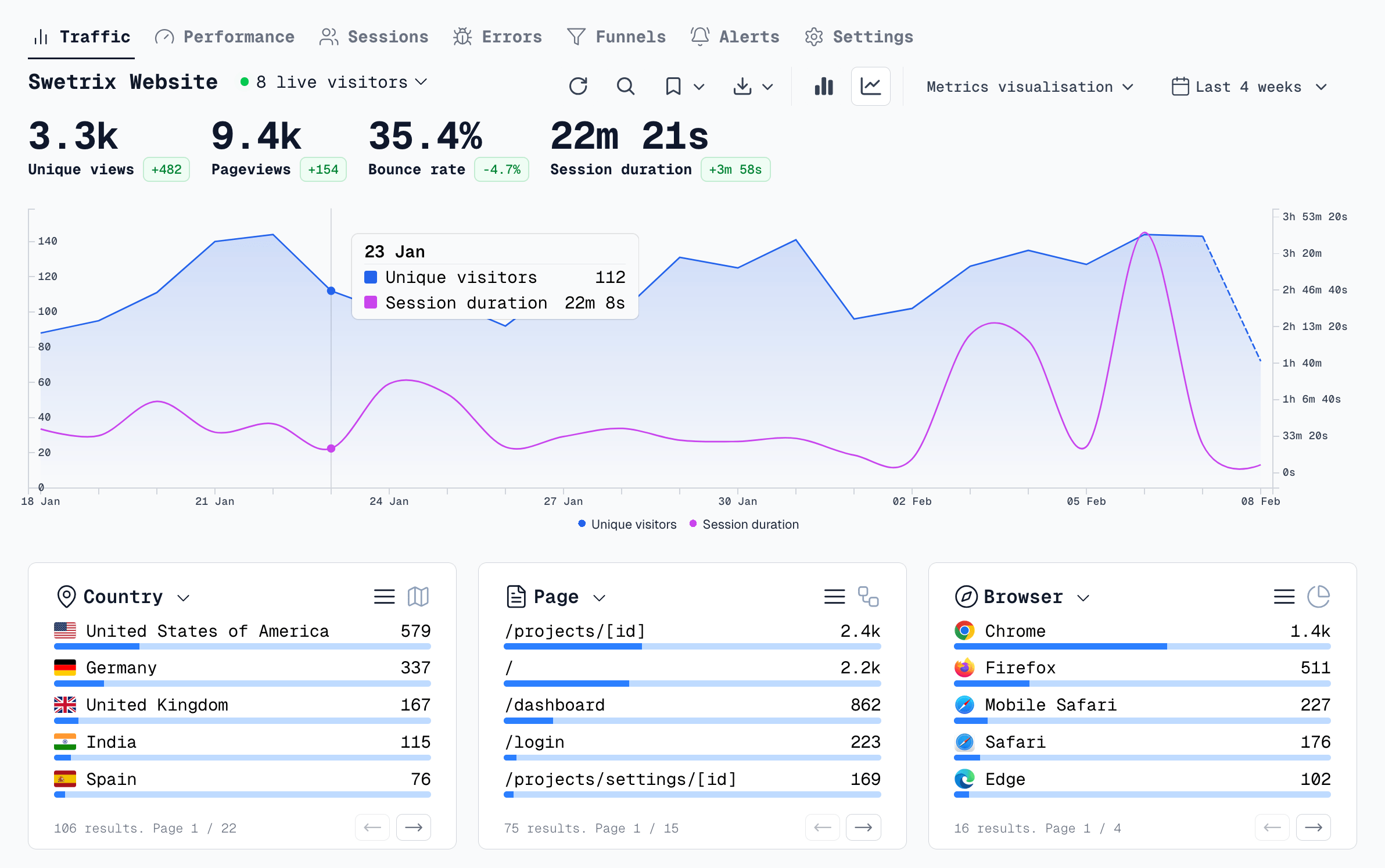
Here is how Swetrix replaces your fragmented data stack and gives your SaaS company the insights it needs.
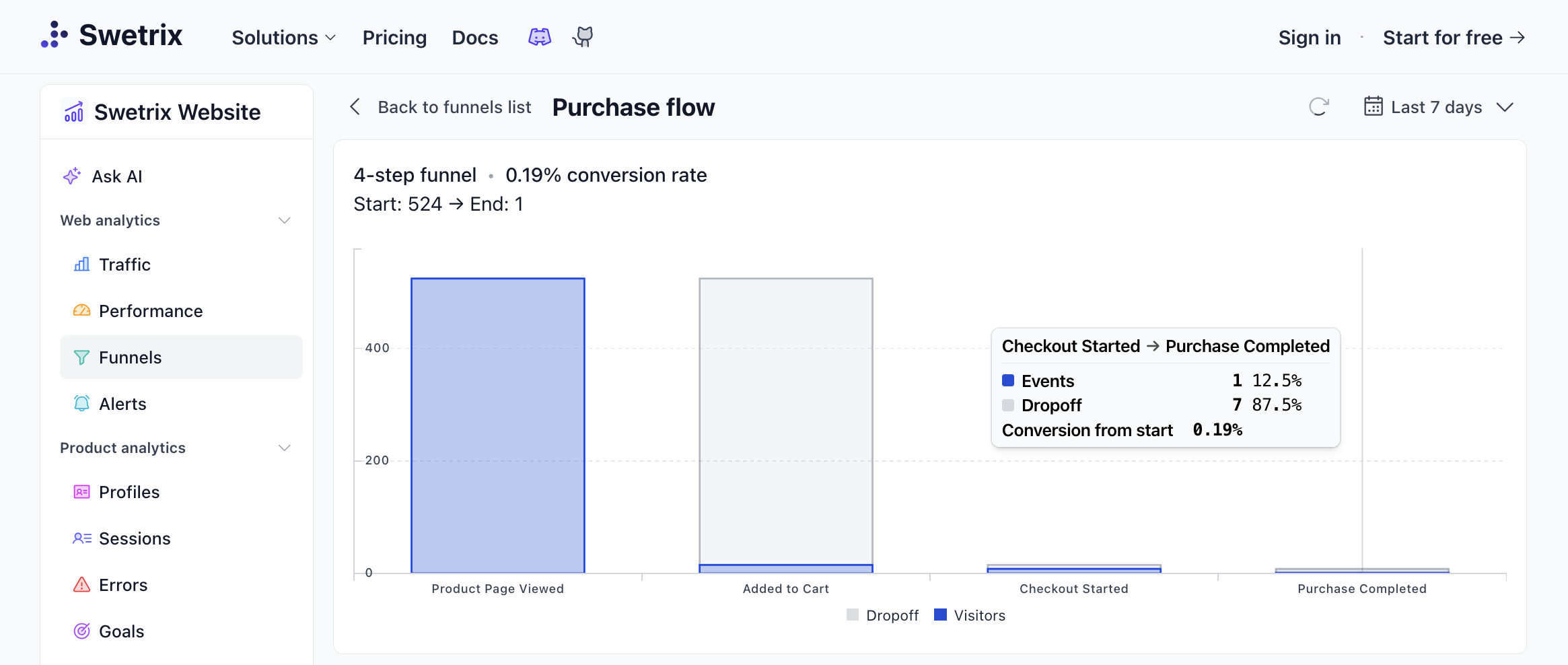
1. Deep Custom Event Tracking & Funnels
Pageviews don't matter inside a web app; actions do. With Swetrix, you can easily define Custom Events for any user action.
Did they click the "Upgrade Plan" button? Did they use the AI assistant? You can track these events and attach rich metadata (like the user's current subscription tier or the specific settings they used).
You can then use these events to build Custom Funnels. For example, you can map the exact conversion rate from Landing Page View -> Account Created -> Workspace Configured -> Premium Plan Purchased, allowing you to pinpoint exactly where users abandon the onboarding process.
2. User Profiles and Session Analysis
Swetrix allows you to tie anonymous marketing traffic to authenticated users. Once a user logs into your SaaS, you can pass their User ID to Swetrix.
This unlocks the User Profiles feature. Instead of looking at aggregate graphs, you can zoom in on a specific user and see their entire journey: how they originally found your site, every page they visited, and every custom event they triggered. When a customer emails support saying, "I can't figure out how to export," you can look at their exact session history to see where they got lost.
3. Integrated Error Tracking
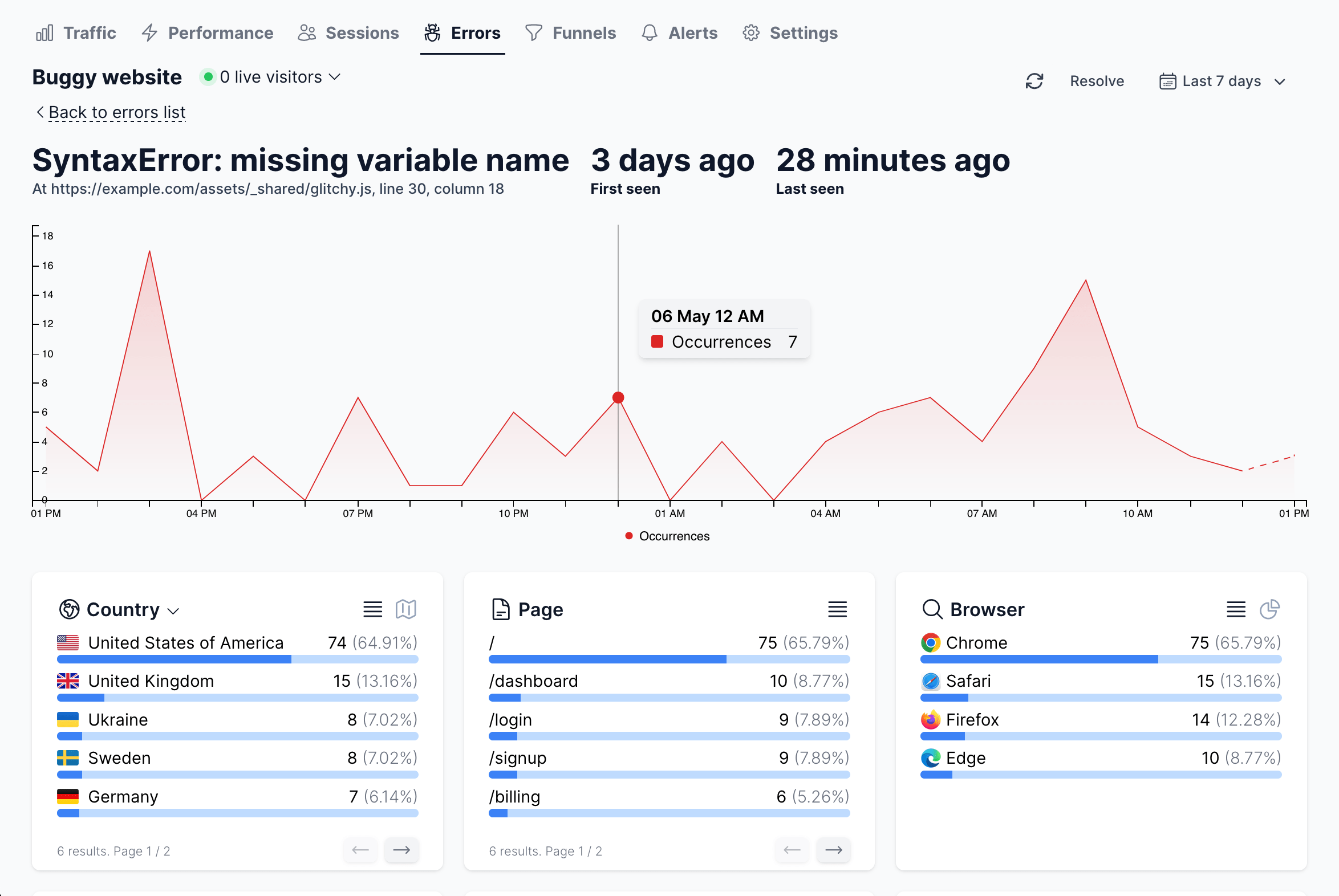
Why pay for a separate, expensive error tracking tool? Swetrix bridges the gap between product and engineering by automatically catching JavaScript errors in your application.
If a recent deployment breaks a core feature, Swetrix doesn't just show a drop in custom events. It shows you the exact stack trace, the browser, and the OS of the users who experienced the crash. You can fix bugs before your users even have time to submit a support ticket.
4. Feature Flags and A/B Testing
Rolling out a major redesign to your SaaS? Don't just push it to production and pray.
Swetrix includes built-in Feature Flags and Experiments. You can roll out a new feature to just 10% of your users and use your Swetrix analytics data to compare their engagement and error rates against the control group. It is enterprise-grade release management, built right into your analytics dashboard.
5. Open-Source, Self-Hostable, and Privacy-First
For SaaS companies dealing with highly sensitive data (like fintech, healthcare, or enterprise software), data sovereignty is non-negotiable.
Because Swetrix is fully open-source, you can self-host the entire platform on your own infrastructure. You maintain 100% ownership of your data, guaranteeing compliance with even the strictest enterprise security requirements. And because Swetrix is cookieless by design, you don't need to bloat your beautiful app UI with intrusive consent banners.
6. Built for Modern Frameworks (React, Vue, Next.js)
Most modern SaaS apps are built as Single Page Applications (SPAs). Legacy analytics tools often struggle with SPAs, requiring messy workarounds to track route changes.
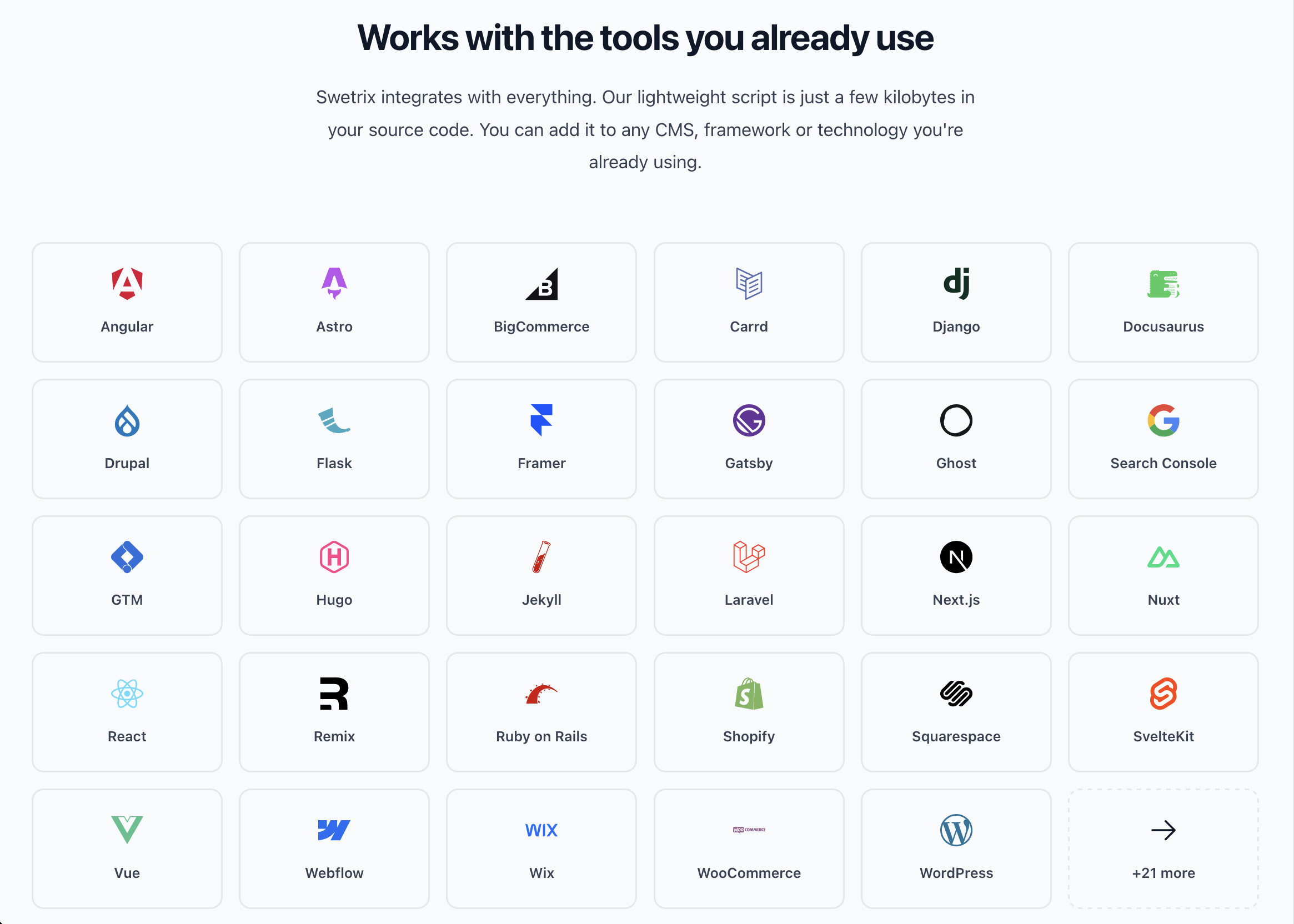
Swetrix works flawlessly with SPAs out of the box. We offer dedicated, lightweight SDKs and integrations for React, Next.js, Vue, Nuxt, Svelte, and more.
Consolidate Your SaaS Data Stack
Stop paying for five different tools to understand what is happening inside your own product.
Swetrix gives you the marketing attribution, the deep product event tracking, the technical error monitoring, and the feature rollout tools you need to grow your SaaS—all in one clean, privacy-friendly, unsampled dashboard.
Start your 14-day free trial of Swetrix today, or check out our GitHub to learn how to self-host it on your own infrastructure.

The web analytics your site deserves.
Tired of bloated dashboards, privacy concerns, and data you can't trust? Switch to Swetrix and get simple, powerful analytics that respects your users.