- Date
Mastering CTR: How to Calculate Click Through Rate Like an Expert
 Andrii Romasiun
So, you want to figure out your Click-Through Rate? The good news is, it's not some arcane marketing metric that requires a data science degree. The calculation is surprisingly straightforward.
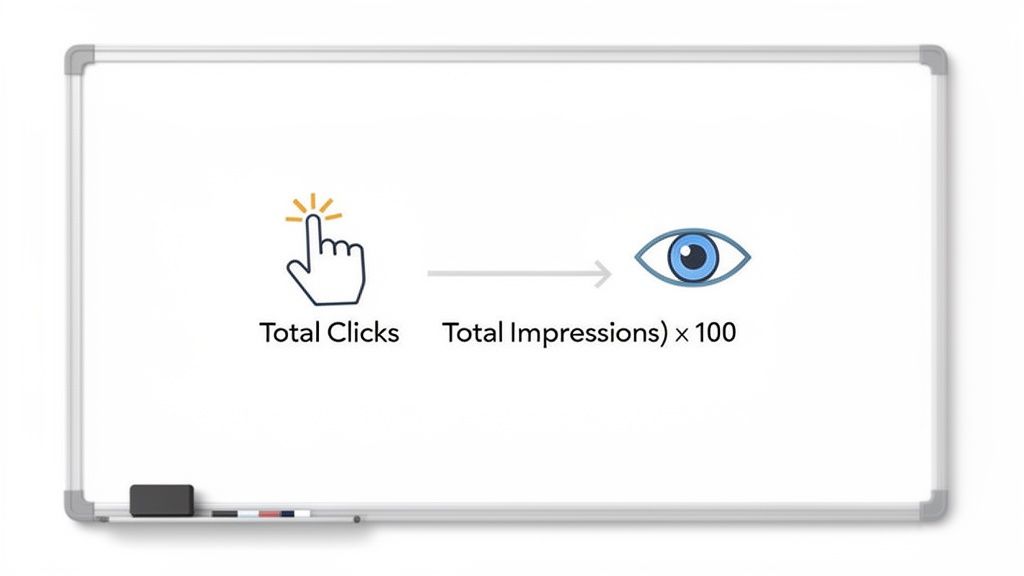
You just need two numbers: the total number of clicks your link got and the total number of times it was shown (impressions). Once you have those, you divide the clicks by the impressions and multiply by 100 to get a nice, clean percentage. It’s one of the quickest ways to gauge if your content is actually grabbing people's attention.
The Simple Formula to Calculate Click-Through Rate
At its heart, the math looks like this:
(Total Clicks ÷ Total Impressions) x 100 = CTR (%)
This little formula tells you the exact percentage of people who saw your link, ad, or email and decided it was interesting enough to click. Think of it as a direct measure of your content's first impression.
Impressions are simply the number of times your content was displayed on someone's screen—whether it’s a search result on Google, a paid ad on Instagram, or a link in your weekly newsletter. A click is just what it sounds like: someone took action.
A higher CTR is usually a great sign. It means your headline, ad copy, or image is doing its job by sparking enough curiosity to earn that click.
Breaking Down the Components
To get an accurate CTR, you need to be crystal clear on what each part of the formula means.
- Total Clicks: This is the raw count of how many times people actually clicked on your link or ad. No ambiguity here—it’s a direct measure of engagement.
- Total Impressions: This is the total number of times your ad or link was displayed. It doesn't matter if the same person saw it five times; that counts as five impressions.
Let’s put it into practice. Imagine your Google Ad was shown 10,000 times (impressions) and it generated 500 clicks.
The math would be: (500 ÷ 10,000) x 100, which gives you a 5% CTR. That single number tells you a whole lot about how well that ad is performing.
If you want to run the numbers without pulling out a calculator every time, you can always use a handy CTR calculator to speed things up.
The CTR Formula at a Glance
Here’s a simple table to keep the core components straight.
| Component | Definition | Example Value |
|---|---|---|
| Total Clicks | The number of times a user clicked on your link, ad, or CTA. | 500 Clicks |
| Total Impressions | The total number of times your link or ad was displayed to users. | 10,000 Impressions |
| CTR (%) | The percentage of impressions that resulted in a click. | 5% |
With these two basic inputs, you can quickly assess the performance of almost any digital marketing effort. It’s a foundational metric for a reason.
Why a 44% CTR in 1994 Is a 2% CTR Today
To really wrap your head around modern click-through rates, you have to appreciate just how different the internet was when the metric was invented. Think back to a time before infinite-scroll feeds, sophisticated ad blockers, and a general distrust of anything that blinked on a screen.
The first-ever banner ad went live on HotWired back in 1994. It was for AT&T, and its novelty earned it a legendary 44% click-through rate. Let that sink in: nearly half of the people who saw it clicked. Fast forward to today, and the average display ad CTR is somewhere between a paltry 0.06% and 0.57%. This massive drop tells a story about how we, as users, have evolved. You can dig deeper into the evolution of click-through rates on Wikipedia if you're curious.
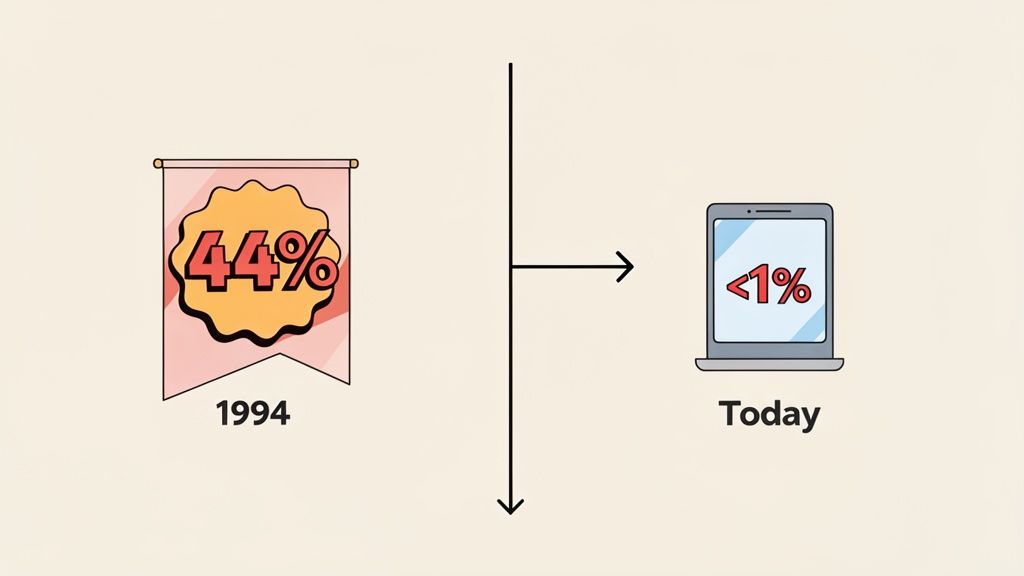
So, what happened? This nosedive wasn't an overnight crash. It was a slow, steady decline caused by decades of over-saturation and a little phenomenon marketers call banner blindness.
The Rise of Banner Blindness
As the web exploded in popularity, so did the ads. We were inundated with flashing, noisy, and often irrelevant banners. In response, our brains adapted. We learned to subconsciously filter out anything that even remotely resembles an advertisement, focusing only on the content we came for. That’s banner blindness.
This learned behavior is critical to remember when you calculate click through rate for your own campaigns. Comparing your numbers to that mythical 44% is a recipe for disappointment. A "low" CTR by 1990s standards can be an absolute home run today.
The game has changed. We're not just chasing any click anymore; we're trying to earn a click from the right person. A well-targeted 2% CTR today is infinitely more valuable than a scattergun 10% CTR was a decade ago because it signals genuine intent.
Moving From Intrusion to Intent
This plummet in ad performance wasn't all bad news; it forced marketers to get smarter. The strategy shifted from interrupting people to aligning with their intent. It's about creating ads and content so helpful and relevant that they feel like a natural part of the user's journey, not a roadblock.
This philosophy now shapes every digital channel:
- SEO: You don't rank by tricking Google. You earn clicks by creating high-quality content that genuinely solves a searcher's problem.
- Paid Ads: The most profitable campaigns use hyper-specific targeting to get in front of people who are already looking for what you offer.
- Email Marketing: Forget generic email blasts. Personalized, segmented campaigns that provide real value are what get opened and clicked.
Knowing this history helps frame your expectations. Chasing a 44% CTR is a waste of time. The real challenge today is to create experiences so compelling that they cut through the noise and earn the attention of a very savvy audience. In the modern marketing world, a good CTR is a badge of relevance and authenticity.
Putting CTR into Practice: Real-World Examples
The basic CTR formula is simple, but what you’re measuring changes depending on where you're looking. A great CTR in an email blast might be a total flop for a Google Ad. Understanding the context behind the numbers is what separates guesswork from genuine insight.
This isn't just about dropping numbers into a calculator. It’s about knowing what those numbers actually mean for different parts of your marketing. Let’s walk through how CTR plays out in three key channels.
Organic Search (SEO)
When we talk about organic search, impressions are the number of times your page pops up on a Google search results page (SERP). A click is exactly what it sounds like—someone saw your link and chose it over the competition. This CTR is a massive signal to search engines that your result is relevant and valuable.
Let's say you wrote a blog post on "Privacy-First Web Analytics." You open up Google Search Console and see it appeared in search results 12,000 times last month. Out of all those potential visitors, 600 actually clicked through to your site.
Here’s the math:
- (600 Clicks / 12,000 Impressions) x 100 = 5% CTR
Getting a 5% CTR from organic search is pretty solid. It tells you your page title and meta description are doing their job, catching the searcher's eye and convincing them you have the answers they're looking for.
Paid Advertising Campaigns
For paid ads on platforms like Google Ads or Facebook, impressions are how many times your ad was shown. Clicks are when a user engages with it. Platforms love high CTRs because it means the ad is relevant and provides a good user experience, which reflects well on them.
Imagine you're running a Google Ad campaign for small business owners. The data shows your ad was displayed 50,000 times and generated 1,500 clicks.
Let's calculate it:
- (1,500 Clicks / 50,000 Impressions) x 100 = 3% CTR
This 3% is a direct grade on your ad's performance—the copy, the visuals, and the targeting. If that number feels low, it’s a clear sign to start A/B testing your headlines or narrowing down your audience. To really nail this, you need to track which campaigns are driving results. You can learn more about using UTM parameters effectively in our guide to see precisely which ads are winners.
One of the biggest mistakes I see is treating every click as a victory. Your ad's CTR just tells you if you got their attention. The real test is the conversion rate that follows. Did that attention actually turn into business?
Email Marketing Campaigns
Email is a different beast. A lot of people get the open rate and the click-through rate mixed up, but they measure two completely different things. Opens tell you who looked. Clicks tell you who acted.
For email CTR, the "impression" is usually the number of emails that were successfully delivered. Let's say you send a newsletter to 8,000 subscribers. Your email provider says it was successfully delivered to 7,900 of them, and from that group, 316 people clicked the main link inside.
Here's how that works out:
- (316 Clicks / 7,900 Delivered Emails) x 100 = 4% CTR
That 4% CTR is a direct reflection of how compelling your email content and call-to-action were. It’s the answer to the question, "Was my message interesting enough to make someone do something?" In many ways, this metric is far more valuable than the open rate because it measures genuine engagement, not just a passing glance.
What Is a Good Click Through Rate for Your Industry?
So, you've got your click-through rate. The big question now is, what does that number actually mean? Is it good? Bad? Just… okay?
The honest answer I always give is, "it depends." There's no magic number that works for everyone. A CTR that’s a huge win for one business might be a sign of trouble for another. It all comes down to context—your industry, the marketing channel you're on, and who you're trying to reach.
A local pizza place running a geo-targeted ad for a "buy one, get one free" deal should expect a much higher CTR than a global B2B software company advertising a complex product to a wide audience. They're playing completely different games.
Channel Performance Matters
On top of your industry, the channel itself makes a massive difference. Think about it: someone actively searching on Google has a totally different mindset than someone scrolling through their social media feed. That intent, or lack thereof, directly shapes whether they click.
This chart shows just how much CTRs can vary across three of the most common channels.
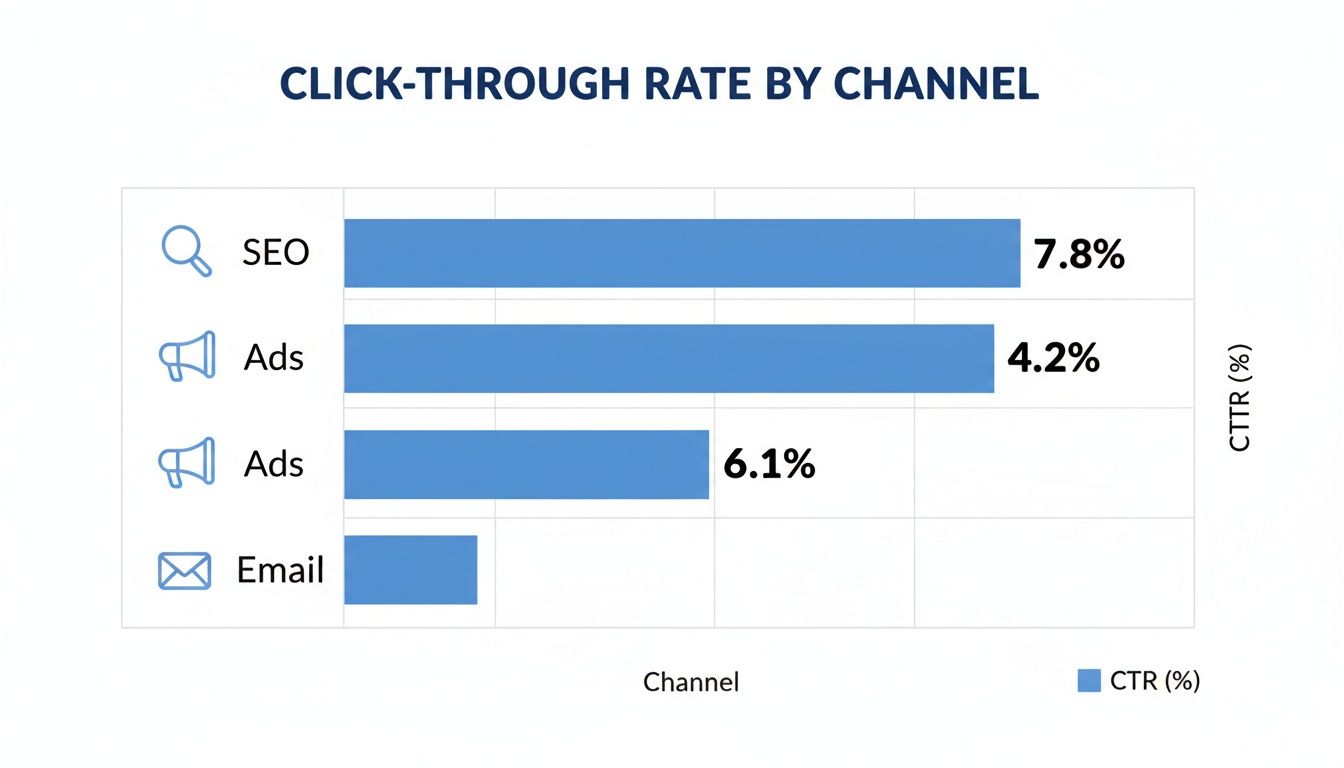
It's no surprise that email and organic search often have higher CTRs. You're usually reaching a warmer audience—people who have either opted into your list or are actively looking for a solution you provide.
Average Click Through Rate by Industry (Search Ads)
To give you a clearer picture, let's look at some paid search benchmarks. When you see the numbers side-by-side, you realize just how much "good" can vary. A 2% CTR might feel low, but in a competitive tech space, it could be right on the money.
| Industry | Average Search Ad CTR |
|---|---|
| Arts & Entertainment | 10.67% |
| Travel & Tourism | 9.19% |
| Real Estate | 7.73% |
| Sports & Recreation | 6.75% |
| Automotive | 6.03% |
| Legal | 4.76% |
| B2B | 2.55% |
| Technology | 2.09% |
Source: WordStream
As you can see, the differences are huge. While these are just averages, they offer a solid starting point for gauging your own performance. For a deeper dive, you can explore more industry-specific advertising statistics to see how your campaigns stack up.
Beyond the Averages
While benchmarks are useful, don't treat them as gospel. They're a guide, not a grade. Several factors can push your CTR well above or below the average.
- Ad Relevance & Quality: Search engines like Google reward ads that closely match user intent. A high Quality Score isn't just a vanity metric; it directly leads to better placements and, often, a higher CTR.
- Audience Targeting: The more you dial in your audience, the better your results will be. A generic, "spray and pray" campaign will almost always get crushed by a highly targeted one.
- Seasonality: A company selling pool supplies is going to have a much better CTR in June than in January. Timing is everything, and seasonal trends can cause major swings in performance.
The best way to use benchmarks is as a diagnostic tool. If your CTR is way off the industry average, it's not a reason to panic. It's a signal to start digging into your ad copy, creative, or targeting to find out why.
Ultimately, the most important benchmark is your own history. Your goal should always be to beat your last campaign. Focus on that continuous, incremental improvement—that's how you build a marketing engine that truly works.
Actionable Strategies to Improve Your Click-Through Rate
Knowing how to calculate your click-through rate is one thing; actually improving it is where the real work begins. A higher CTR isn't just a number to brag about—it's a clear signal that you're resonating with your audience. Search engines and ad platforms love this, often rewarding you with better visibility and lower costs.
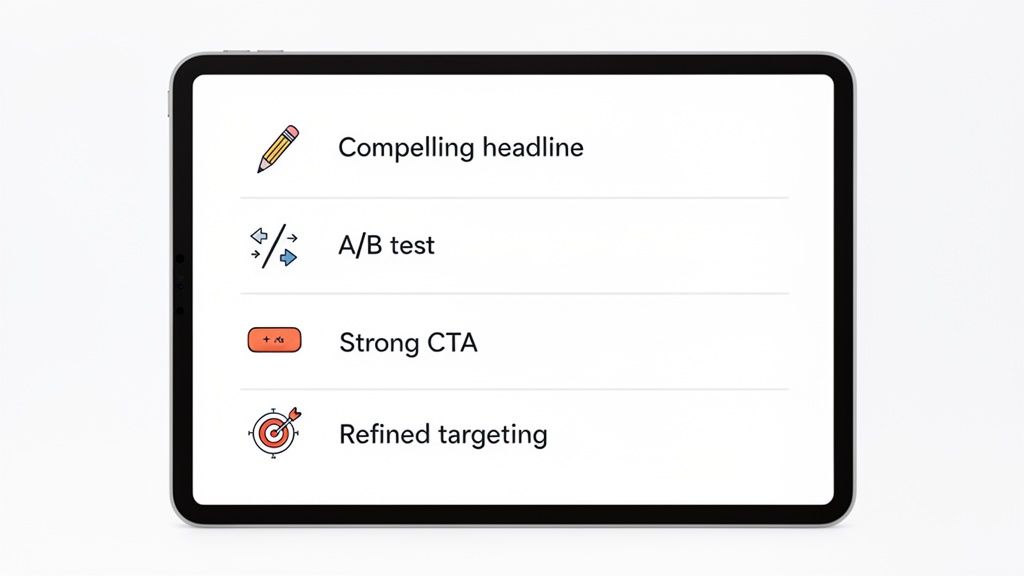
If you want to boost your CTR, it all comes down to one core idea: relevance. The more your content aligns with what a user is looking for, the higher the chance they’ll click. Getting this right is a mix of art and science, blending compelling copy with laser-focused audience targeting.
Refine Your Copy and Creative
Your headline and ad copy are your first impression. In a crowded feed or search result page, they might be your only shot to grab someone's attention. Generic, bland messaging is a recipe for being ignored.
To make people stop and click, you have to speak directly to their problems and emotions.
- Use Power Words: Sprinkle in words that create urgency or trigger a feeling. Think "instantly," "proven," "risk-free," or "exclusive." These words give your copy a little extra punch.
- Ask Questions: Instead of just stating what you do, frame your headline as a question your ideal customer is already thinking. "Tired of Complicated Analytics?" hits a lot harder than "Easy-to-Use Analytics Software."
- Include Numbers: Digits just pop on a page full of letters. Headlines like "7 Ways to Improve Your SEO" or "Save 30% Instantly" are visually disruptive and promise a clear, specific outcome.
And don't forget the visuals. Whether it’s a display ad or a social media post, use high-quality, eye-catching images or videos that actually match your message. Steer clear of those generic stock photos everyone has seen a thousand times.
Dial In Your Audience Targeting
You could write the most brilliant, persuasive ad in history, but if it's shown to the wrong people, your CTR will flatline. One of the fastest ways to see a jump in performance is to stop wasting impressions on people who will never care.
In paid advertising, a low CTR is often a targeting problem, not a creative one. Before you rewrite your ad for the tenth time, check to see if you're reaching the right people. It's much easier to improve your CTR by showing a good ad to the perfect audience than showing a perfect ad to a mediocre one.
For search campaigns, get aggressive with negative keywords to filter out irrelevant searches. On social media, layer demographic, interest, and behavioral targeting to build a super-specific audience profile. The more dialed-in your targeting is, the more relevant your ad will be to every single person who sees it.
Embrace A/B Testing
Never fall into the trap of assuming you know what works best. A/B testing (or split testing) is your best friend here. It’s the simple practice of comparing two versions of something—a headline, an image, a call-to-action button—to see which one gets more clicks. You’d be amazed at how a tiny change can make a massive difference.
To get clean, reliable data, just test one thing at a time. For instance:
- Test CTA Button Text: Pit "Get Started" against "Claim Your Free Trial."
- Test Ad Headlines: Try a benefit-driven headline versus a question-based one.
- Test Visuals: Keep the copy identical but swap out the image.
Platforms like Google Ads and Facebook Ads have A/B testing tools built right in, making it easy to get started. Over time, these small, data-driven tweaks compound into major improvements. The principles are also closely related to what you'd do for on-page conversions; our guide on conversion rate optimization best practices dives deeper into that.
Finally, remember that a solid SEO foundation is the ultimate long-term play. Backlinko's data shows that securing the #1 organic spot on Google yields an average 27.6% CTR. Compare that to the 2.8% CTR for the #10 position, and you can see why ranking high is so critical.
Digging Deeper: Common Questions About CTR
Even once you’ve got the basic formula down, a few tricky questions always seem to surface when you start applying CTR in the real world. Getting these details right is the difference between just spitting out a number and actually understanding what it’s telling you about your marketing efforts.
Let's clear up a few of the most common hangups.
Impressions vs. Reach: What’s the Real Difference?
This is easily one of the most common points of confusion. People often use "impressions" and "reach" interchangeably, but they measure two completely different things. Using the wrong one will throw your CTR calculation way off.
- Impressions are the total number of times your content was shown on a screen. If a single person sees your ad five times, that’s 5 impressions.
- Reach, on the other hand, is the number of unique people who saw your content. In that same scenario, your reach is just 1.
So, why do we stick with impressions for CTR? Because CTR is all about the effectiveness of each individual showing. It answers the question, "When someone saw this ad, how likely were they to click it?" If we used reach, we’d be ignoring the impact of repeat viewings, which are often a deliberate part of a campaign strategy.
"My CTR Is Amazing, but My Conversion Rate Is Terrible. What Gives?"
Ah, the classic marketer's headache. You’ve nailed the creative, your headline is a masterpiece, and you're getting a ton of clicks. But none of those clicks are turning into sales, sign-ups, or whatever your goal is. It’s a frustrating spot to be in, but the culprit is almost always the same: there's a major disconnect between your ad and your landing page.
A high CTR is a great sign! It means your ad is doing its job—it's grabbing attention and compelling people to act. But that click creates an expectation. If your landing page doesn't immediately deliver on what the ad promised, visitors will hit the back button without a second thought.
Think of it this way: Your ad writes a check, and your landing page has to cash it. A high CTR with a low conversion rate means you're writing checks your landing page can't cash. The problem isn't getting people to the party; it's that the party isn't what they were promised.
What causes this mismatch? It’s usually one of these things:
- A confusing user experience: The page is a mess, and people can't find the "buy now" button.
- Mismatched messaging: The ad promised a 50% discount, but the landing page talks about a free trial.
- Painfully slow page speed: Nobody has the patience to wait for a page to load. They’ll just leave.
Can I Even Calculate CTR for My Website’s Internal Links?
You absolutely can, and you absolutely should. This is a seriously underrated tactic for understanding how people navigate your website. By tracking internal link CTR, you can map out popular user journeys, see which on-page calls-to-action are working, and find opportunities to improve your site's flow.
The formula is identical, you just define the terms a little differently:
- Clicks are simply the number of clicks on a specific internal link.
- Impressions are the number of pageviews for the page where the link appears.
Let’s say your homepage got 10,000 views last month. On that page, you have a link to your "Pricing" page that was clicked 800 times. The CTR for that internal link is 8%. This kind of data is gold for optimizing how you guide visitors from one page to the next, pushing them closer to your most important goals.
Tracking these metrics—from massive ad campaigns right down to a single link on your blog—is the key to making smarter decisions. Swetrix offers privacy-first web analytics that give you these crucial insights without scooping up personal user data. See for yourself and turn your traffic into clear, actionable data by starting your 14-day free trial at swetrix.com today.