- Date
The Best Privacy-First Alternative to Similarweb in 2026
 Andrii Romasiun
Enterprise market intelligence platforms drain operating budgets. A standard subscription to legacy analytics tools starts in the thousands and scales into the six figures. Intelligence vendors build their reports using third-party panels, browser extensions, and scraped internet service provider logs. You pay a premium for competitive intelligence, but these modeled datasets misrepresent traffic volumes for mid-sized websites.
By dropping tracking cookies and switching to a privacy-first alternative to similarweb, businesses cut overhead costs and eliminate data privacy liabilities. Stop paying for external estimates and start tracking absolute traffic numbers on your own domain. Review your current analytics stack today to identify platforms that rely on user fingerprinting or third-party behavioral panels.
The Hidden Costs and Blind Spots of Traditional Market Intelligence
Vendor business models require upselling disparate modules. Companies sign multi-year contracts expecting pinpoint accuracy across competitive traffic analysis. Account managers then restrict features behind paywalls.
Exorbitant Pricing Tiers
Software costs for legacy intelligence platforms escalate without warning. An entry-level web intelligence plan costs around $1,500 per year. For comprehensive access, enterprise pricing often reaches six figures annually. You pay base fees for platform access, then incur separate charges for sales, shopper, or stock intelligence add-ons. Each module adds another $20,000 to $60,000 to the contract.
Vendors restrict historical data access to three months on starter plans. To view year-over-year trends, businesses must upgrade to the premium tiers. These companies also charge per user seat. Sharing insights across the marketing department inflates the bill.
Audit your software expenditure this week. Pull the billing statements for your marketing and analytics stacks, then compare the annual cost against the specific metrics your team references in reports. If your department limits tool usage to checking referral traffic and basic keyword positions, cancel the six-figure contract. Marketers use dedicated SEO tools for backlink data and privacy-focused platforms to track internal website traffic.
The 40 to 70 Percent Accuracy Gap
High price tags create an illusion of precision. Intelligence vendors estimate traffic by analyzing global panels of users who install tracking extensions. For major conglomerates with tens of millions of monthly visitors, the large sample size produces reliable trends. A panel of 10 million users offers enough data points to model traffic for Amazon or Wikipedia.
When website traffic falls below 500,000 monthly visits, the panel methodology breaks down. Data analysts comparing the server logs find these estimated traffic models often miss the mark by a significant margin for B2B and niche e-commerce domains, though this error range varies depending on industry category and audience demographics. The tracking panels lack sufficient data points to model specific audiences, causing your team to base marketing budgets on distorted graphs.
Competitor traffic metrics serve as vanity numbers. Knowing that a rival site receives an estimated 50,000 visits provides zero improvement to your conversion rate. External estimates distract marketing departments from internal optimization. Stop using third-party estimates to measure domain performance. Deploy a first-party tracking script to capture unmodeled pageviews, and compare the direct logs against the third-party dashboard. The discrepancy in the raw visitor count dictates whether the expensive intelligence tool warrants renewal.
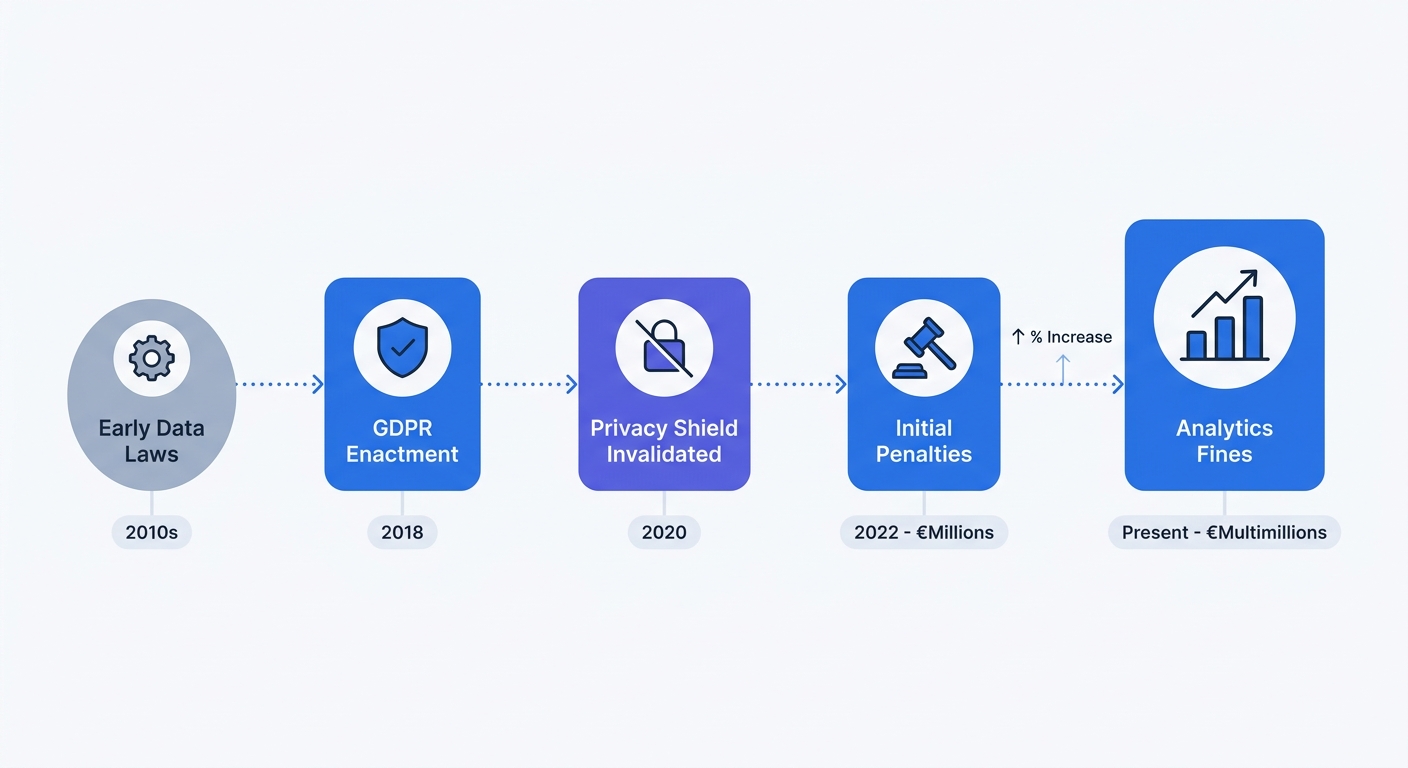
The Rising Financial Risk of Ignoring Data Privacy
Regulators view broad behavioral tracking as a compliance violation. Data protection authorities treat unauthorized third-party data collection as grounds for maximum penalties. Modern data teams must align their tracking architecture with global privacy frameworks.
Escalating GDPR Enforcement and Fines
Since 2018, European regulators have issued billions of euros in GDPR penalties. Enforcement agencies target tracking architectures that process user data without explicit consent. In late 2024, the Irish Data Protection Commission issued a 310 million euro fine against LinkedIn for unlawful behavioral analysis. The commission established that pre-checked boxes and assumed consent fail the legal test for ad tracking.
Inspect your website headers for third-party tracking pixels by opening the browser developer tools and clicking the network tab. Reload the homepage to list every domain receiving data payloads. Remove any scripts that send IP addresses or behavioral profiles to external ad networks without a prior user opt-in.
Regional Data Protection Nuances
Privacy compliance extends beyond the European Union, as global lawmakers force companies to adapt tracking mechanisms for different jurisdictions.
California dictates strict data sharing rules through the CCPA, granting consumers the right to opt out of the sale of personal information. Traditional market intelligence tools aggregate user panel data and sell those insights back to enterprise clients. Relying on these panels places your business in a complex legal position regarding data brokers.
Canada regulates commercial data practices through PIPEDA, while Brazil enforces the LGPD. Managing separate consent banners for every global region requires geolocation scripts that slow down the site and break page caching. Standardize the tracking approach by adopting the highest privacy standard across all regions. Cookieless architecture meets the requirements of multiple privacy frameworks at once, allowing you to abandon geolocation consent scripts. Visitors receive a fast, banner-free experience regardless of their physical location.
The Technical and Compliance Advantages of Cookieless Analytics
Third-party cookies break website performance and create legal vulnerabilities. Transitioning away from persistent identifiers resolves both technical and compliance hurdles.
Ditching the Intrusive Cookie Banner
Consent pop-ups interrupt the user experience. Visitors arrive at a landing page and face a wall of configuration toggles, prompting many to hit the back button rather than untangling the privacy options. This initial banner creates friction at the exact moment a prospect enters the conversion funnel.
Deploying cookieless platforms eliminates the need for these banners. By processing zero personally identifiable information, first-party analytics tools operate outside the scope of consent requirements. The software records aggregate metrics like total pageviews, referrers, and device types without storing a tracking cookie on the user device.
Delete the cookie banner and test the page load speed using a performance monitoring tool like Lighthouse. Removing the third-party consent script reduces the initial rendering time, improves core web vitals, and presents a clean interface to new visitors.
Achieving 100 Percent Data Capture
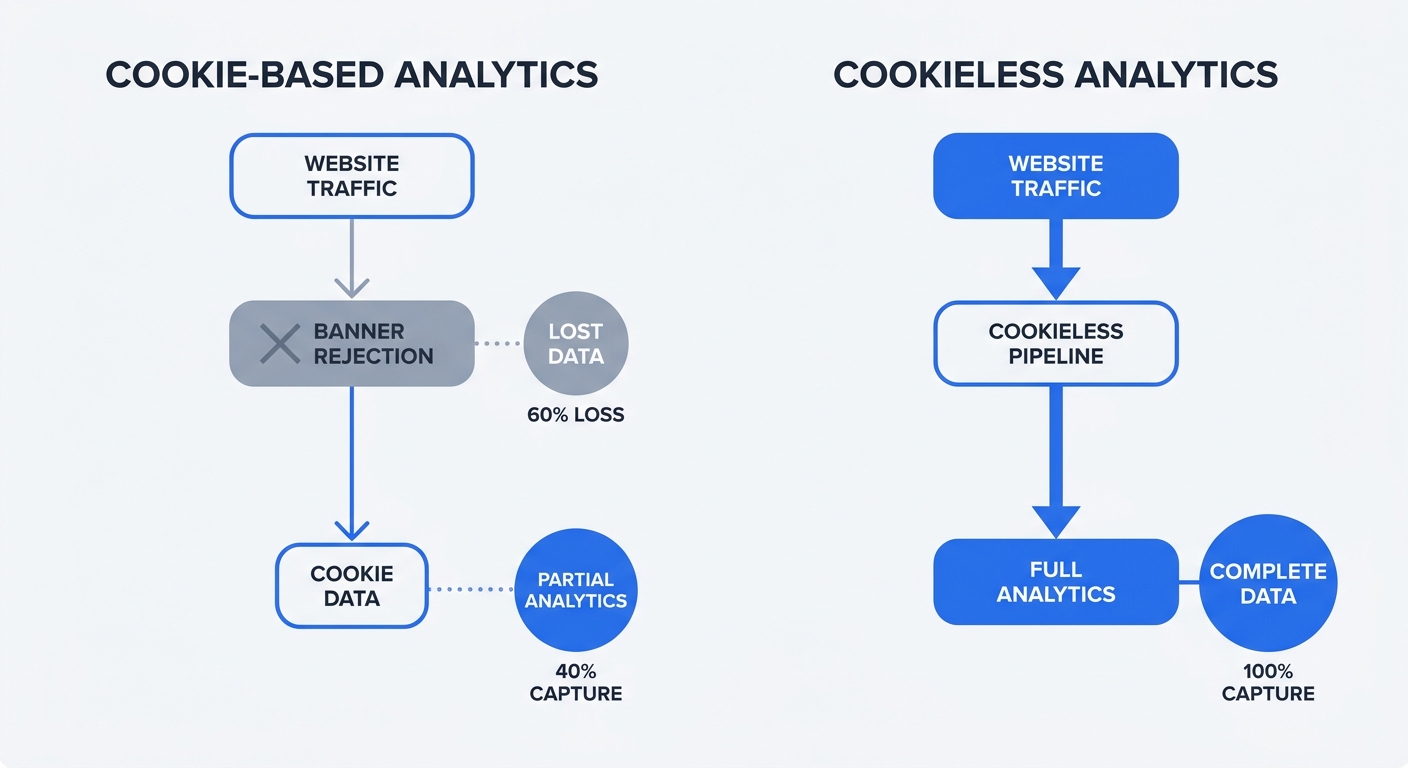
Consent-based tracking fractures the dataset. When users decline tracking cookies, traditional analytics vendors stop recording their sessions. A site might receive 10,000 visitors while the dashboard displays only the 4,000 who clicked the acceptance button. Marketing teams then calculate conversion rates using flawed denominators.
Cookieless scripts capture every hit without requiring opt-ins, recording the session the moment the page loads. Marketing directors see the absolute volume of traffic moving through the funnels.
The mechanics of cookieless tracking rely on temporary hashing. The server generates a random salt each day, which the script combines with the user IP address and user agent to create a unique identifier. At midnight, the server deletes the salt to make the hashes irreversible. This process guarantees anonymity while allowing the system to distinguish unique sessions within a 24-hour window.
Draft a transition plan to replace the current tracking stack by identifying the core conversion events. Set up a cookieless platform in parallel with the legacy system and let both run for thirty days. Compare the visitor counts to reveal the missing segment of users who reject traditional tracking.
Evaluating a True Alternative to Similarweb
Replacing a complex intelligence suite requires clear categorization. You must separate platforms built for competitive keyword research from software designed for precise website analytics.
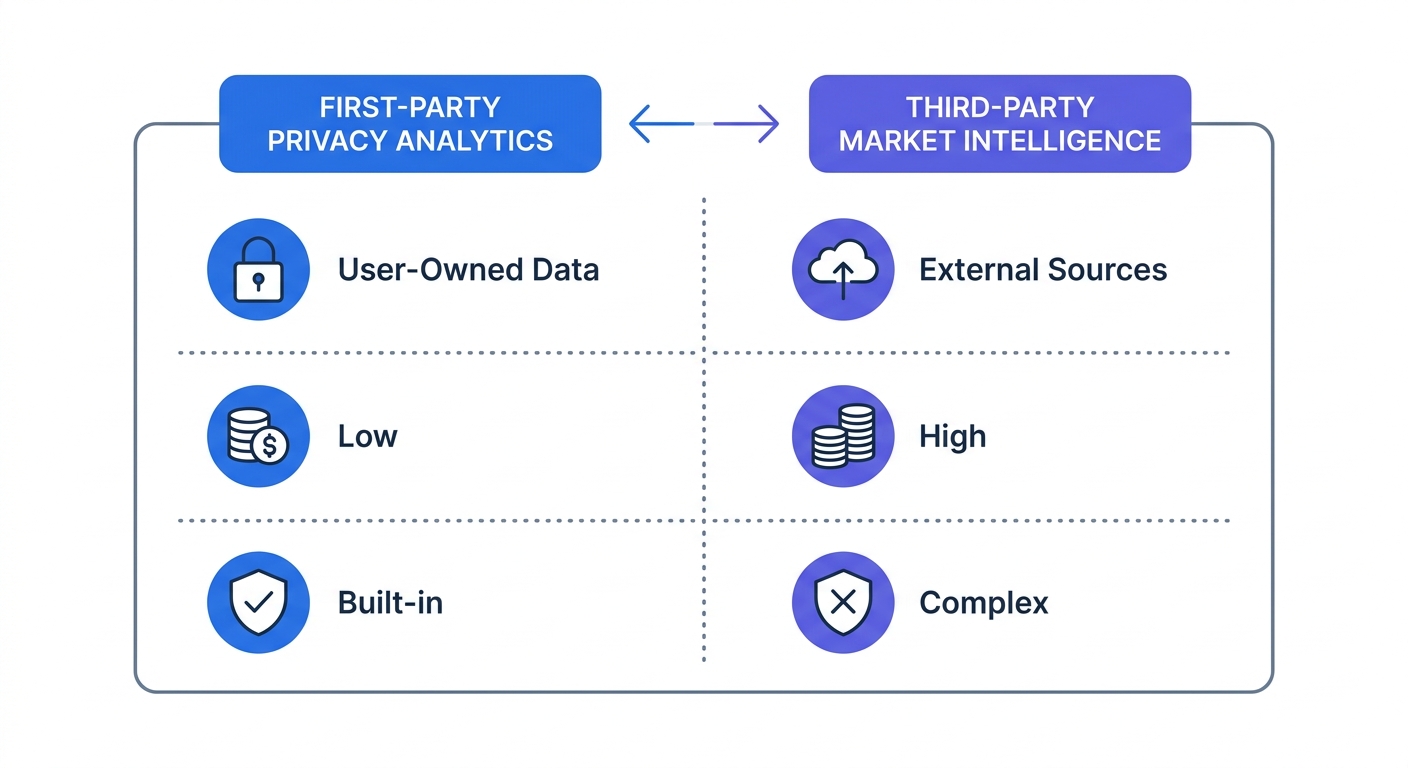
First-Party Accuracy vs Third-Party Estimates
Marketers use SEO software to map broader search engine trends. Platforms like Ahrefs and Semrush provide backlink profiles and search volume estimates. They act as market intelligence tools but avoid the behavioral user panels that trigger privacy concerns.
First-party privacy analytics track internal domain metrics. Platforms like Swetrix log the hard data of who visits, what pages they read, and where they convert on a specific domain.
| Feature | Legacy Market Intelligence | First-Party Privacy Analytics |
|---|---|---|
| Data Source | Third-party panels, ISP logs | First-party domain hits |
| Accuracy | 40-70% margin of error for small sites | 100% accurate for installed domains |
| Annual Cost | $1,500 to $150,000+ | $0 to $500 (depending on traffic) |
| GDPR Compliance | High risk, requires banners | Fully compliant, no consent needed |
| Primary Use Case | Broad competitor estimations | Precise internal performance tracking |
Define the business requirements before buying software. If the marketing team needs to monitor competitor keyword rankings, purchase an SEO suite. If the operations team requires absolute accuracy regarding internal traffic sources, deploy a first-party analytics platform rather than expecting one tool to perform both tasks.
Evaluating Open-Source Infrastructure
Transparency dictates the reliability of an analytics platform. Proprietary software companies hide data collection methodologies behind closed server environments, forcing customers to trust corporate marketing materials regarding anonymization.
Open-source analytics eliminate this blind faith. Independent security researchers verify privacy claims by auditing the public code repositories, confirming the script hashes IP addresses and drops tracking parameters.
Deploying open-source software gives engineering teams flexibility to choose between managed cloud hosting or self-hosted environments. Self-hosting places the database on internal company servers, guaranteeing no third-party vendor ever touches the raw website traffic data.
Review the GitHub repositories of prospective analytics tools. Check the commit history for regular software updates and active community engagement. A stagnant repository indicates neglected development, so buyers should choose platforms with transparent public roadmaps.
Transitioning to a Privacy-By-Design Analytics Workflow
Swapping analytics tools requires an organized deployment. A methodical rollout guarantees continuity in reporting metrics while you upgrade the privacy standards.
Implementing Your New Tracking Setup
Client-side tracking offers the fastest launch method. Site administrators copy a lightweight snippet of code and paste it into the head section of the website. The script executes when the browser loads the page, requiring less than five minutes to configure.
Server-side routing provides superior resilience against ad blockers. Engineering teams configure a reverse proxy to send pageview events from the server to the analytics endpoint. The user browser communicates exclusively with your domain to keep the data under direct internal control.
Follow these steps to deploy a custom tracking domain:
- Open the DNS provider dashboard.
- Create a new CNAME record pointing
analytics.yourdomain.comto the analytics provider server. - Generate an SSL certificate for the new subdomain.
- Update the tracking script source URL to match the new custom domain.
Create an account with a privacy-focused analytics provider. Add the website domain to the dashboard to generate a project ID, then choose an integration method. For maximum control, review the server-side documentation and route the tracking requests through your backend architecture.
Tracking Core Business Metrics
Legacy platform vendors overwhelm marketers with irrelevant data points, packing dashboards with hundreds of charts that display screen resolutions, arbitrary engagement scores, and predicted user demographics. This software bloat distracts teams from analyzing revenue-generating metrics.
Modern data teams prioritize macro-level performance by tracking total visitors, referral sources, and conversion events. These three metrics dictate whether marketing campaigns generate a return on investment.
Configure the new dashboard to track activation events by opening the project settings. Define a custom event for specific conversion actions, such as newsletter signups or product purchases. Map these events to confirmation page URLs or checkout button clicks to build a lean reporting structure that highlights business growth.
Fixing Attribution with UTM Parameters
A visitor clicks a Facebook ad on a mobile device. That evening, the same user searches the brand on a laptop and makes a purchase. Both touchpoints drove the sale, but default analytics configurations attribute the conversion to the last click and ignore the initial advertisement.
UTM parameters fix this attribution gap. Each tagged link carries the traffic source, medium, and campaign name into the analytics dashboard. Append string variables like ?utm_source=facebook&utm_medium=cpc&utm_campaign=spring_sale to the advertisement URLs. The platform parses these tags on page load to file each visit under the correct campaign.
Without tracking tags, paid and organic traffic blur together in the reports. A $5,000 ad campaign might drive 300 conversions that register as direct traffic because the links lacked source parameters. Tag every external link to make revenue attribution visible across the entire marketing department.
Track five parameters per link: source, medium, campaign, term, and content. Source and medium remain mandatory, while the other three add granularity for A/B tests and keyword-level tracking.
Tagging mistakes compound across thousands of clicks. A misspelled campaign name splits the traffic data into two separate rows. Standardize naming conventions in a shared spreadsheet before launching any new marketing initiative. Build consistent links using a UTM generator to prevent capitalization errors.
Stop paying enterprise prices for estimated third-party data. Take control of your website metrics with an open-source, cookieless platform that respects user privacy. Start your free trial at Swetrix.com today and implement accurate, compliant analytics in under five minutes.